


 21:16
21:16


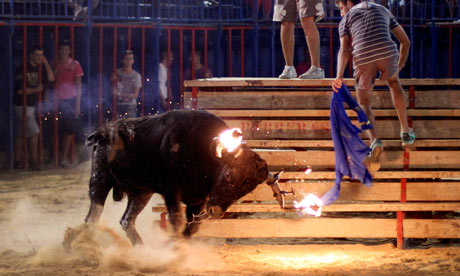
It is the end of a long career, deemed venerable by those who admire Spanish fighting bulls.
In the early hours of Sunday morning, the half-tonne 11-year-old killer bull known as Ratón, or Mouse, will feel a bullring's sand under his hooves and sniff the scent of commingled human adrenaline and fear for the last time.
Those who pay their €2.50 (£2.20) in Canals, eastern Spain, will witness the final chapter of a life spent chasing, and occasionally goring, people. Fans are expected to arrive from around the country.
Many will be secretly hoping Ratón, who has killed two and reportedly gored five others in his career, will draw blood at his valedictory outing in the small town near Valencia. A fiesta poster promises "a show with the presence of the famous Ratón" starting at 12.30am. It does not mention that Ratón killed a spectator in nearby Xátiva last month and another man in 2008.
Canals mayor, Ricardo Cardona, claims to have been unaware of Ratón's bloody past when hiring him. He has asked the bull's owner, Gregorio de Jesús, to prevent members of the public coming face to face with the beast.
Four professional recortadores, or bull-taunters, will instead dodge in front of him in the bullring, encouraging him to chase them over obstacles for up to half an hour.
"It is when someone jumps in spontaneously that things inevitably happen," De Jesús said this month.
Police and security staff will try to prevent enthusiastic amateurs jumping into the ring with Spain's most infamous bull.
The future of Ratón, who is past retirement age, remains uncertain. De Jesús wants to clone the bull but is waiting to hear if he will receive local government funds to pay for it.
 U.S. deep-sea explorers must turn over to the Spanish government 17 tons of silver coins and other treasure recovered from a sunken Spanish galleon in 2007, a federal appeals court ruled Wednesday. But Tampa, Fla.-based Odyssey Marine Exploration has vowed to continue the protracted legal battle over the cache, which could be worth as much as $500 million. In a statement Wednesday, the company said it would take the next step in the appeals process, requesting a hearing before all the judges of the 11th Circuit Circuit Court of Appeals. That came after a three-judge panel of the 11th Circuit had issued its ruling in a case that could case spill over to treasure hunts for years to come. "We are certainly disappointed by the 11th Circuit's ruling," said Melinda MacConnel, Odyssey's vice president and general counsel. "We believe the U.S. Constitution and all other applicable laws give jurisdiction to the U.S. courts to determine the rights of Odyssey, Spain and all other claimants in this case." Attorneys for Odyssey asked the three-judge panel to overturn a lower court ruling and uphold the "finders keepers" rule that would give the treasure hunters the rights to coins, copper ingots, gold cufflinks and other artifacts salvaged in April 2007 from the galleon found off the coast of Portugal. Spain's lawyers countered that U.S. courts are obligated by international treaty and maritime law to uphold Spain's claim to the haul. The ship, called the Nuestra Senora de las Mercedes, was sunk by British warships in the Atlantic in 1804 while sailing back from South America with more than 200 people on board. Odyssey created an international splash in May 2007 when it announced that it had recovered more than 500,000 silver coins and other artifacts from the wreck and flew the treasure back to Tampa. Spain went to the U.S. District Court in Tampa, where the company is based, claiming ownership. Odyssey disputed the Spanish government's ownership of the valuable cargo. James Goold, a Washington attorney who represented the Spanish government in court, called the appeals court decision "a complete and much-deserved victory." "The court recognized that stripping the sunken Spanish ship of coins to sell to collectors is no more appropriate than to do that to the USS Arizona in Pearl Harbor," Goold said. "We are pleased and gratified that the court recognized U.S. obligations under international law, just as Spain respects the sanctity of sunken U.S. Navy ships." A federal judge sided with Spain in the first round of the tug-of-war in June 2009, accepting the Spanish government's argument that it never surrendered ownership of the ship and its contents. Attorneys argued the case before the 11th Circuit panel in May. Odyssey had argued that the wreck was never positively identified as the Nuestra Senora de las Mercedes. And if it was that vessel, then the ship was on a commercial trade trip — not a sovereign mission — at the time it sank, meaning Spain would have no firm claim to the booty. International treaties generally hold that warships sunk in battle are protected from treasure seekers.
 Designer clothes owned by Hollywood legend and fashion icon Elizabeth Taylor, including haute couture by Chanel, Yves St. Laurent and Dior, will be sold at auction in New York, Christie's said on Wednesday. The silk chiffon dress that the Academy Award winning actress wore for her first wedding to actor Richard Burton will be among the nearly 400 times included in the four-day series of sales in December. "One of the many great treasures within Elizabeth Taylor's vast collection is her extraordinarily well-preserved wardrobe," said Marc Porter, chairman and president of Christie's Americas. "The stunning outfits she wore to galas, award ceremonies, AIDS benefits and even her own weddings to Richard Burton are all here, lovingly maintained along with the handbags, shoes, hats and other accessories that completed her superstar looks," he added in a statement. The December 13-16 sales, which span over 50 years of fashion, will follow a global three-month tour which will also includes Taylor's renowned jewelry, fine art and memorabilia. It will be the second in a series of auctions from the estate of the legendary film star who died in March. Nearly 6,000 people viewed the collection this month when it was displayed in Moscow. Stops in Los Angeles, London, Dubai, Geneva, Paris, Hong Kong and New York will follow. Meredith Etherington-Smith, Christie's' curator for the fashion auction, described the items as "a highly personal collection." "This is not a red carpet wardrobe edited by stylists but a treasure trove of looks chosen by the last of the great movie stars. Many of the pieces in this lifetime collection were couture, custom made for Ms. Taylor by designers who became her close friends, including Valentino Garavani, Gianni Versace and Gianfranco Ferre." Some 68 of Taylor's most iconic looks will be auctioned at a gala evening sale on December 14, followed by hundreds of other fashion items and accessories in other sales. Highlights will include a Versace beaded evening jacket arrayed with portraits of the actress in some of her famous movie roles, which is estimated to sell for up to $20,000. The sunflower yellow dress by Hollywood designer Irene Sharaff that Taylor wore to her 1964 wedding to Burton has an estimated sale price of $40,000 to $60,000. Taylor's estate was valued at up to $1 billion when she died of congestive heart failure at age 79. A portion of the proceeds from the exhibitions, events and publications related to the auction will be donated to The Elizabeth Taylor AIDS Foundation, which the actress founded in 1991. The series of Taylor sales are individually devoted to jewelry, haute couture, fashion and accessories, decorative arts and memorabilia from Taylor's Bel Air home, and Impressionist and modern art.
 Hosted and created by Bodegas Paternina at its Conde de los Andes winery in Ollauri, the exhibition entitled “Tinta, Sangre y Vino” – “Ink, Blood and Wine” – celebrates the writer’s visit to the winery 55 years ago and marks 50 years since his death.


 Located on the Southern Spanish Costa del Sol, in the heart of the 'Golden Mile' only 5 minutes to Old Town Marbella and Puerto Banús, with 320 days of sunshine and a mild year round average temperature of 21ºC). Open year round, the renowned Marbella Club Hotel, was once the private residence of Prince Alfonso von Hohenlohe. The 121 luxury bedrooms and suites, spread over the beach front resort, harmonize with 14 Andalusian-Style villas throughout 42,000 square meters (452,083 sq. ft.) of lush subtropical gardens. Each guest room is decorated with the finest fabrics and Mediterranean interior design, reflecting the surrounding elements and has furnished balcony / terrace and spacious luxurious bathrooms with separate shower and bath. The 14 charming villas are in the unmistakable style of the Hotel, faithful replicas of traditional Andalucían architecture, blending harmoniously with their surroundings, and are ideal for families and guests seeking to enjoy more space and privacy. The 2, 3 or 5 bedroom villas have their own private garden and heated pool, providing guests with both comfort and privacy during their stay. Both of the 2 outdoor heated swimming pools, one with seawater invite you to relax in the surrounding gardens or to enjoy the views of the Mediterranean through the palm trees of the famous beach club.
 Swiss bank UBS on Sunday increased the amount it said it had lost on rogue equity trades to $2.3 billion and alleged a trader concealed his risky deals by creating fictitious hedging positions in internal systems. UBS stunned markets on Thursday when it announced unauthorised trades had lost it some $2 billion. London trader Kweku Adoboli was charged on Friday with fraud and false accounting dating back to 2008. "The loss resulted from unauthorised speculative trading in various S&P 500, DAX, and EuroStoxx index futures over the last three months," UBS said in a brief statement. "The loss arising from this matter is $2.3 billion. As previously stated, no client positions were affected." Global stock markets have been extremely volatile in recent months, plunging on concerns over euro zone and U.S. debt crises and then rebounding on hopes for their resolution. The loss is a disaster for the reputation of Switzerland's biggest bank, which had just started to recover after it almost collapsed during the financial crisis and faced a damaging U.S. investigation into aiding wealthy Americans to dodge taxes. "Loss even more. Reads like they're making excuses," said Helvea analyst Peter Thorne of the UBS statement. The new scandal has prompted calls for its top managers to step down and for its investment bank to be split into a separate unit from its core wealth management business. Chief Executive Oswald Gruebel, who was brought out of retirement in 2009 to turn the bank around, was quoted in a newspaper on Sunday as saying he is not considering quitting over the crisis, but said it was up to the board to decide. In a memo to staff on Sunday, he said: "Ultimately, the buck stops with me. I and the rest of senior management are responsible for dealing with wrongdoing." Swiss newspapers quoted unnamed insiders as saying the UBS board and important shareholders such as the Singapore sovereign wealth fund were still backing Gruebel, with immediate changes at the top the last thing the bank needed. Gruebel is widely expected to present plans to drastically cut back the investment bank at an investor day in November. INDEPENDENT INVESTIGATION The bank, whose three keys logo symbolise "confidence, security, discretion," has pulled its "We will not rest" global advertising campaign for now, that was designed by advertising agency Publicis to try to rebuild its image. Meanwhile, UBS client advisers have been writing to customers to reassure them of the underlying financial strength of the bank despite the trading loss, a spokesman said. "That we now suffer this setback at this point in our efforts to improve our reputation is very disappointing. This incident also sets us back somewhat in our capital-building efforts," Gruebel said in his memo. "However, I wish to remind you that our fundamental strengths as a firm remain intact... we remain one of the best capitalized banks in the industry. UBS said its board of directors had set up a committee chaired by independent director David Sidwell, former chief financial officer at Morgan Stanley, to conduct an independent investigation into the trades and the bank's control systems. The bank said it had covered the risk resulting from the unauthorised trades, and its equities business was again operating normally within previously defined risk limits. It said the trader had allegedly concealed the fact his trades violated UBS risk limits by executing fake exchange-traded fund (ETFs) positions. "Following inquiries directed to him by UBS control functions that were reviewing his positions, the trader revealed his unauthorised activity," the bank said. "The positions taken were within the normal business flow of a large global equity trading house as part of a properly hedged portfolio," UBS said. "However, the true magnitude of the risk exposure was distorted because the positions had been offset in our systems with fictitious, forward-settling, cash ETF positions." The Sunday Times cited unnamed insiders saying the trader placed bets worth $10 billion before his losses were detected. ETFs are index funds listed on an exchange and can be traded just like regular stocks. They try to replicate index performances and offer lower costs than actively managed funds, but regulators have warned about risks from some complex ETFs. In the past three months, DAX futures have fallen 22 percent, Eurostoxx 50 futures have dropped 20 percent and S&P 500 futures have dipped 4 percent. The instruments involved in the UBS case are similar to those that Jerome Kerviel, the rogue trader at Societe Generale, traded when he racked up a $6.7 billion loss in unauthorised deals in 2008. Christoph Blocher, vice-president of the right-wing Swiss People's Party (SVP) -- the country's biggest -- renewed his calls for a splitting off of the investment bank. "One has to seriously examine a ban on investment banking for commercial banks," he told the SonntagsZeitung, adding his party might team up with the center-left Social Democrats to push for such a move.
 Lawyers for a woman who alleges she was sexually assaulted by Prince Alwaleed bin Talal of Saudi Arabia say the case has not been properly handled by Spain's criminal justice system. The woman, known only as "Soraya", says she was assaulted on a yacht moored off the island of Ibiza in 2008. A spokeswoman for the prince denied the allegation and said he had not been to Ibiza for more than a decade. The case was shelved by an island court but has now been reopened. This followed a successful appeal by Soraya's lawyers. The judge is preparing a second official request to the Saudi authorities for assistance in formally questioning the prince. The nephew of Saudi King Abdullah, Prince Alwaleed bin Talal is a multi-billionaire with major investments in both Citigroup and NewsCorp. 'Something in my drink' "In our opinion, the Court of Instruction No 3 in Ibiza and the police did not follow full procedure in cases of alleged sexual abuse," the lawyers from Madrid-based firm Turiel and Beloqui told the BBC. "There are things that should have been investigated that were not - like questioning staff on the yacht and the guests, an analysis of the victim's clothes and so on," the lawyers wrote, describing the fact these steps were not taken as "very unusual". The claim that the case was not being pursued with proper rigour was dismissed by the Ibiza court in 2010, saying that the identity of the accused in no way affected its decision to drop the case that year. The court ruling cites insufficient evidence to proceed. Continue reading the main story “ Start Quote My daughter was in a terrible state, [...] scared to death, crying, awful” Mother of 'Soraya' Soraya, a Spanish-German model, was 20 at the time of the alleged attack on 13 August 2008 on board the 117-metre luxury yacht Turama. She told police she had begun to feel nauseous in the VIP zone of a local night club, where she believes something was slipped into her drink. She had been taken there by a man claiming to be a chauffeur for "an Arab prince" who was visiting the island. According to court documents seen by the BBC, Soraya sent the chauffeur an SMS text message at 05:12, saying: "I haven't drunk much but I think there was something in my drink." The model says she came round some hours later on board the Turama to find a man on top of her. She later identified the man as Prince Alwaleed bin Talal using images taken from YouTube. Forensic reports from a medical examination the following day revealed traces of a sedative and semen, but no physical injuries. A woman identifying herself as the mother of Soraya told the BBC her daughter had called on the morning of the alleged attack asking her to come and collect her from the island. "My daughter was in a terrible state, [...] scared to death, crying, awful," the woman said, responding to questions sent by email. "The Spanish justice system has treated this case very badly. In my view they did not want to get too involved because of who the accused was." A 2010 prosecutor's report says three men who were questioned by police during the investigation were unable to corroborate the model's version of events "in any way". The Saudi foreign ministry rejected an initial request from the Ibizan court to investigate, citing "an inability to identify the accused and a lack of solid evidence". This week, a spokeswoman for Prince Alwaleed's Kingdom Holding Company said the prince had never been informed of the 2008 court case, or that it was eventually shelved. In a statement, she also said the billionaire's travel records confirm he was with dozens of friends and family at the time of the alleged attack, nowhere near Ibiza. "There have been many examples of people impersonating Prince Alwaleed over the internet and elsewhere for their own purposes," Heba Fatani said in a statement. She called the allegations against him "salacious" and "completely and utterly false". The Audencia Provincial court in Mallorca - which has jurisdiction over Ibiza - has ordered the case to be reopened in order to ensure the prince can be questioned in accordance with Spanish law. Soraya's lawyers have urged him to provide a DNA sample to rule himself out of the inquiry.


